© 2010-2011 SABINE DA SILVA ALL RIGHTS RESERVED
Showing posts with label c. Chapters 11-15. Show all posts

(11) Community, Part 1

There are several famous musicians who were brought up in the Calliope. Among those you might have heard of are the Neville brothers, and rappers Master P, C-Murder, and Lil Romeo. I'd like introduce you to a visual artist who I had the great fortune of knowing. While I have not revealed real names of school community members thus far, Lories Thornabar, is an exception because his talent deserves to be shared and remembered.

One boundary edge of our school in the Calliope was lined with single family homes and one of these homes sat across the street from our playground fence where students assembled. Every morning, the resident, an African American gentleman in his mid sixties, would sit on the top step of his stoop with a large painting propped up to face the street. The themes of his paintings would change as the weeks would go by, and each day, both the children and their families would check to see what he had in store for them. Mr. Thornabar would greet everyone who passed by on the way to school with a smile and a positive affirmation. It was a nice start to our mornings.

While I would wave back at Mr. Thornabar every day, I also wondered about his story. The school staff had apparently known him for years, but only across the fence. After a few months, I decided to go over there and introduce myself, but I ended up getting a lot more than I had bargained for.

Mr. Thornabar answered the door in his usual jovial manner and invited me in to talk. Just as an aside, my father once told me that I was a child who was likely to end up on a milk carton because I loved talking to strangers. In any case, I accepted his invitation and stepped inside and this was where I was met by the most extraordinary space, decorated with paintings from floor to ceiling. These works of art were created on old scrap pieces of wood and on the actual walls themselves. The style of his house was a typical New Orleans "shotgun" with high ceilings and where each room was connected to the other going straight back from the front door. As we walked through each of the rooms to get to the kitchen, I was enveloped in art, history and community.

Image: painting by Lories Thornabar, Black Mona Lisa)

(12) Community, Part 2

I was surprised to find someone else in the kitchen. Mr. Thornabar introduced me to a woman who was boiling water for tea in a pot on the stove. She was his sister who lived with him and they seemed to be about the same age. The kitchen felt very warm and I realized that the oven door was deliberately left open. They explained that the oven was the only source of heat for the house.

As Mr. Thornabar and I sat down to talk at the kitchen table, his sister excused herself and walked toward an armchair in the next room. He seemed happy to have a visitor and very open to sharing his story which included a career in the Navy and a later disability that left him essentially homebound. It was at that time he took up painting and when he could not afford canvas or artist paint, he used old boards and house paint mixed with tints. When he ran out of boards, he would paint over them and when he ran out of those, he painted on the walls.

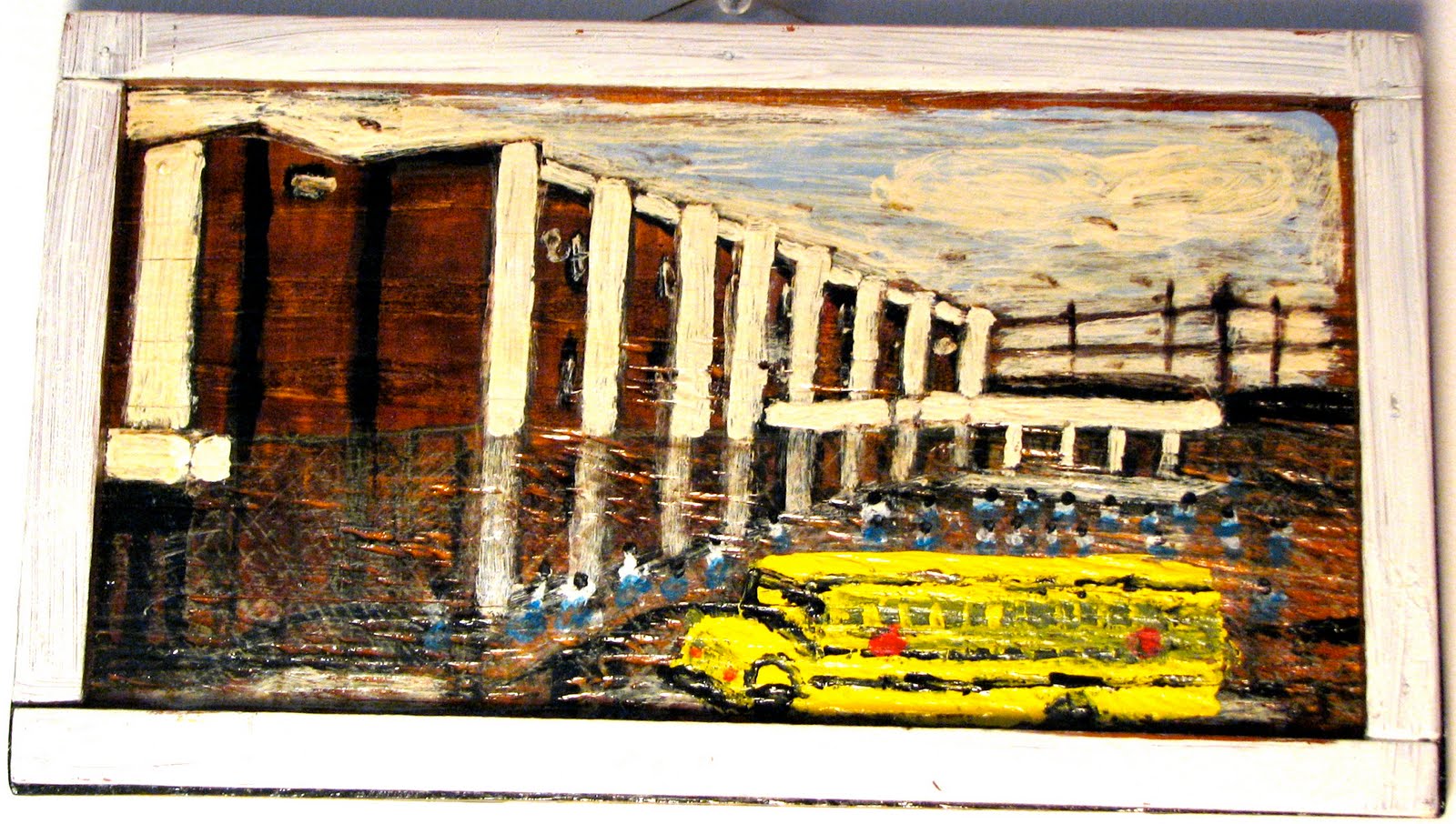
The subjects of his work ranged from famous New Orleans landmarks, like St. Louis Cathedral, the now infamous New Orleans Superdome, Streetcars, but also cartoon characters, Santa Claus and the Easter Bunny. In his house we were surrounded by portraits civil rights leaders alongside Zulu kings and queens and Mardi Gras Indians (see links). These paintings were hung beside images of people in the community going about their daily lives. He even painted a picture of the school where I worked, with a yellow school bus waiting out front.

While talking, my eye focused on the painting of our school, so I asked about it and if he sold his work. He replied, "Yes", and when I inquired about the price, he said, "Seven dollars." This seemed like a ridiculously low price to me, but given his small income, he seemed to think that it was fair. Not sure how to negotiate upward, I offered him thirty dollars and he accepted.

I worked in the Calliope for three years and purchased several paintings from Mr. Thornabar during that time. What made him even happier was that I was able show off his art to more buyers. As the demand went up, he was able to raise his prices and took pride in being a working artist.

After leaving the Calliope, I lost touch with Mr. Thornabar. When I returned to see him in 2002, I was surprised to be greeted by his sister at the door. She was happy to see me, but sad to tell me that he had passed away from kidney disease a few months earlier. She now lived in the house alone.

While Mr. Thornabar never had formal training or showed in a museum, his form of art, like Grandma Moses', could be categorized as "outsider art". The impact he made as an artist was in the genuine way he documented the everyday events of the community and and found beauty, elegance, warmth and grace in a place that most people found terrifying. I would estimate that his public stoop paintings were viewed by several thousand people over the years.

Image: painting by Lories Thornabar, Calliope School, 1986

For more info on Zulu:
http://www.kreweofzulu.com/
For more info on Mardi Gras Indians:
http://en.wikipedia.org/wiki/Mardi_Gras_Indians

(13) Mrs. Prentiss In Memorium

While Mrs. Prentiss reign of terror was deeply disturbing, so was the behavior of the adults around her, including myself. We were educators who had invested our lives in the welfare of children yet, we allowed her to continue the emotional and physical abuse of children. I'm sharing what I learned with you because there are many forms of Mrs. Prentiss in the world, both in and out of the classroom, and in rich and poor communities everywhere. It's important to unpack how these people settle in to power so that we can alter the dynamic and prevent abuse. This is my take:

Mrs. Prentiss had a strong ideology. She herself had broken from the cycle of poverty of her childhood and wanted the same for her students, however the methods she chose were questionable. As one of our fellow blog readers, writes, "The teacher must have felt that humiliation would pull [her students] out of poverty." This resonates with another ideology, that of the American Puritans who believed that the state of bring poor was a result of moral depravity. Perhaps Mrs. Prentiss believed that physical suffering would lead her students to their moral and economic salvation.

As a 27 year veteran teacher in the community, she had taught two or three generations of students. Parents weren't likely to complain about her because they themselves had "experienced" her.

The staff and administration were equally intimidated. As the teacher's union representative Mrs. Prentiss was actively involved with negotiations with the school district. If you were a teacher, you needed Mrs. Prentiss as your advocate. The principal needed her support so that he could work with his staff effectively and keep his job. And the district needed to be on her good side as she was a member of the union team that negotiated the teacher contract and salaries.

These systemic aids enabled her poor behavior, and there was one additional and important contributing factor that existed, a quality that most abusers share. Mrs. Prentiss was sometimes nice. Not fake nice, but really nice. This left her students and all the rest of us confused just long enough before the next wave of abuse hit, and the cycle continued. This is a hard lesson for adults to learn, nevermind children. How do you reconcile your definition of a monster when there are moments when they draw you in lovingly?

Mrs. Prentiss went on to teach for a total of 30 years and retired the same year I left the school. I went to her retirement luncheon where there were hundreds of people in attendance, no former students though. Speakers described her work as a teacher and all of the important advances that she had contributed to as the union representative, all valid in some way.

I lost touch with her after that, but looked her up last month only to find that she passed away from cancer a year ago.

(14) CP3

I didn't want to presume that I was qualified to write about gangs. So, I'm posting a video today (aprox 7 mins. long) to give you another perspective on the Calliope, where I worked and where my students lived. I want to preface this clip by saying, please keep in mind that it is only one of many contrasting perspectives. Missing are the voices of mothers, grandmothers, children and the many men who never involved themselves in gang life.

What you are going to see is real and the life that my students experienced around them. The nature of the Calliope forced children to grow up quickly because of the adult language and situations to which they were exposed.

The documentary, Straight from the Projects - Rappers that Live the Lyrics, was produced in 2003, two years before hurricane Katrina hit the city. It is narrated by rappers Ice-T and C-Murder. C-Murder actually grew up in the neighborhood and speaks from his own experience. Both rappers give a glorified, yet no holds barred account of the CP3.

**Please be advised that scenes contain adult content.**

(15) Bribes and Consequences

After the first few challenging days with my students, things settled down quickly, especially after three students, all boys, were placed on extended suspensions pending expulsion hearings at the district office. I'll post more on them in weeks to come.

Now I was left with thirty fifth grade students (ages 10-11), and while they all had their own issues, we were off and running as a class. That said, they seemed to have their own collective agenda - to test my patience and strength on a minute by minute basis. They did this by constantly talking out of turn, cursing, leaving the classroom without permission to go to the restroom, breaking pencil points on purpose, and chewing gum loudly and incessantly. While I did have firm rules and consequences which I enforced, to be quite honest, my students weren't phased by them at all. They had lived through much harsher situations out in the world like witnessing drug deals and shootings, so by giving them my textbook punishment, I was really instead rewarding them with the one-on-one attention which they craved.

So, how did I get my students to buy into MY education agenda? I did it the old fashioned way, by bribing them with the things that meant the most to them. Starting with bubble gum. For most teachers, the no gum chewing rule is a sacred tenet, usually because gum smacking is disturbing to others and students tend to leave a mess under their desks or seats. I decided to work with their likes and did what I'm sure accelerated my nomination straight into the bad teacher hall of shame, I did allow my students to chew gum in class.

When I first proposed the idea, they were a little thrown (This is good. Always keep your students on their toes). We had a talk about why we should chew quietly and why the trash can was the only sensible receptacle to discard old gum. Another concession made (this was their idea) was that they were allowed to get up from their seat without permission to throw away gum. I let them know that if these conditions weren't met, we'd go back to the no gum chewing policy and the whole thing would be ruined for everyone. All I asked in return, was for their undivided attention while I was teaching.

I was pleasantly surprised by how well my students, for the most part, abided by our social contract and there were some added benefits. While I'm not a dentist, I've read studies where gum chewing (sugarfree) is in some cases encouraged for good oral health. Another benefit, is that the repetitive motion of chewing can be soothing (think of baseball players as an example), and finally, it's hard to chew and talk at the same time.

I'll share more unusual strategies in posts to follow and would like to hear what you've succumbed to with your students or with your own children for the sake of furthering your personal agenda.